What makes integration of warehouse barcode scanners with ERP systems so complex?
Kennis
July 1, 2026
Miranda van Tellingen
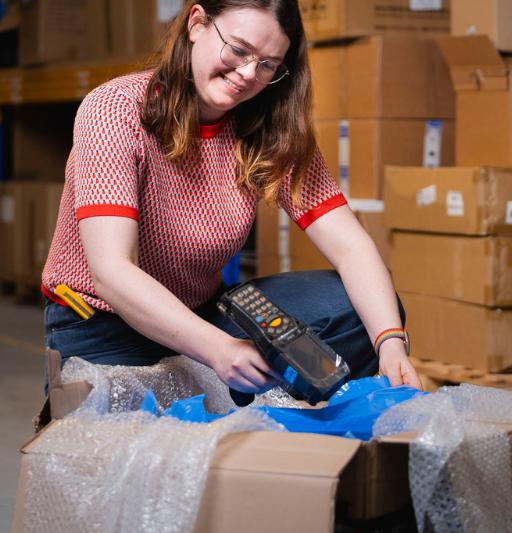

Scanning is simple, the chain behind it is not
Scanning a barcode takes a fraction of a second. But what happens afterward is much more extensive:
- The scanner reads a barcode
- The app translates the scan into an action (e.g. receiving or picking)
- Data is transmitted via Wi-Fi or a mobile network
- Validation may take place in middleware or an API layer
- The ERP processes the transaction
- Inventory and status are updated
If any of these links slows down or fails, it immediately disrupts warehouse operations.
1. The scan: the starting point of a digital chain
Everything begins the moment a barcode is scanned on a handheld scanner, rugged device, or vehicle terminal.
At that point, more is happening than simply reading a code:
- the scanner converts the barcode into data
- an application links the scan to an action (for example receiving or picking)
- context is added (location, user, order)
What seems simple is, in reality, already the first step where variation is introduced. Different devices and apps often process the same scan in different ways.
2. The network: the invisible link between warehouse and IT
After the scan, the data must be transmitted to a backend or ERP system. This usually happens via Wi-Fi or a mobile network.
This is precisely where unpredictability often arises:
- warehouses have varying coverage due to racking and infrastructure
- devices continuously switch between access points
- connections temporarily drop due to congestion or distance
When this happens, the scanner environment must be able to switch to offline mode. Data is then stored locally and synchronized later. Proper handling of these situations largely determines the reliability of the entire process.
3. The scanner app: where logic and process come together
The application on the device determines how a scan is interpreted.
A barcode can have different meanings depending on the process:
- goods receipt
- internal transfers within the warehouse
- order picking
- inspection or returns
The scanner app adds process logic such as:
- validations (does the location or order match?)
- sequencing (is this step allowed at this point?)
- user feedback
This is often the point where standard solutions are no longer sufficient. Every warehouse operates differently, meaning the application must adapt to the practice, not the other way around.
4. Integration layer: how data reaches the ERP
Between the scanner and the ERP there is usually an integration layer. This can be an API, middleware, or a custom-built connection.
This layer determines how data is processed technically:
- real-time via API calls
- batch-based via exports
- or hybrid models with caching and synchronization
The main challenge is consistency. Data must not only arrive in the ERP, but also be correctly translated into the right transactions and inventory movements. Any deviation in this process can directly lead to incorrect stock levels.
5. ERP system: processing transactions
The ERP system is the endpoint of the chain, where all scans ultimately come together in inventory, orders, and logistics processes.
But there are major differences here as well:
- some ERP systems process transactions in real time
- others rely on batch processing or approval workflows
- data models vary significantly per vendor or implementation
This means the same scan can lead to different outcomes in different ERP environments. The scanner chain must therefore always be aligned with the ERP’s logic.
6. Data and processes: the foundation of reliability
Even when the technology works perfectly, the quality of data and processes ultimately determines the result.
Common issues include:
- missing or incorrect barcodes
- inconsistent product structures
- unclear warehouse locations
- differing working methods between teams
When this foundation is weak, every step in the chain becomes unreliable, regardless of the quality of hardware or software.

The role of Reverse IT in this chain
Reverse IT focuses on the hardware layer and device management within this chain. This includes:
- Supply of industrial scanners and mobile devices
- Setup and management of mobile hardware
- Tools for device management, updates, and monitoring
- Support for stable and scalable device environments
In many projects, Reverse IT works together with ERP and software partners who are responsible for integration and business logic. It is precisely this collaboration that ensures the entire chain, from scan to ERP, functions reliably.

The step toward a reliable warehouse environment
The integration of warehouse barcode scanners with ERP systems is complex because it is not a single connection, but a chain of dependencies. Every step, from scan to network, from application to ERP, influences the final result. Organizations that design this chain as a whole rather than as separate components build a far more stable and scalable warehouse system.
Reverse IT supports the hardware and device management layer, ensuring that the foundation of this chain remains reliable and manageable, in collaboration with specialized ERP and software partners.