Green vs. Red scan beam
Kennis
June 22, 2026
Miranda van Tellingen
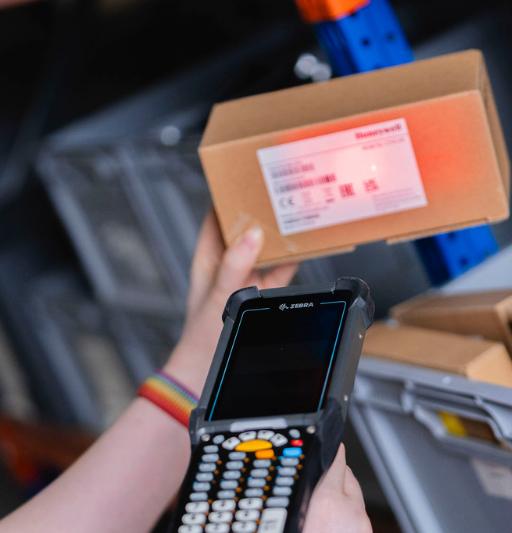
The technology behind the scan beam
In logistics and warehousing, every second counts. Any delay in the scanning process—a forklift driver taking too long to aim at a barcode on a high rack, or an operator losing sight of the aiming beam in bright sunlight—costs valuable time and reduces efficiency. When deploying or upgrading a PDA fleet, Reverse-IT looks beyond simply selecting the right device. The critical question is: which scan engine should power the hardware? Do we choose the traditional red laser, or make the switch to the innovative green laser?
The fundamental difference between a red and a green laser scan beam lies in the wavelength of the light and how the human eye perceives it. Light is measured in nanometers (nm). A standard red scanner aimer typically operates at a wavelength of approximately λ ≈ 650 nm. A green laser, on the other hand, has a shorter wavelength, usually between λ ≈ 520 nm and 550 nm.
Why does this matter? The human eye is naturally far more sensitive to green light than to red light. Under photopic (daylight) vision conditions, the eye reaches its peak sensitivity at λ = 555 nm. As a result, a green laser can appear four to six times more visible to an operator than a red laser, even when both emit the same amount of energy.
This enhanced visibility makes a significant difference in real-world warehouse and logistics environments. Operators can acquire targets faster, maintain accuracy over longer distances, and continue scanning efficiently in brightly lit areas or outdoor conditions. The result is a smoother scanning process, fewer missed scans, and improved overall productivity.
The key differences
Switching from red to green is about much more than color. These are the three key advantages for logistics operations:
1. Visibility in Challenging Lighting Conditions (High Ambient Light)
In warehouses with bright LED lighting, distribution centers with extensive skylighting, or outdoor scanning environments such as cross-docking and yard management, a red laser beam can quickly become difficult to see. Operators often need to search for the aiming dot, causing delays. A green laser PDA remains highly visible and sharply defined even under high ambient light levels. This significantly reduces aiming time and speeds up every scan.
2. Scanning Range and Long-Range Performance
When scanning barcodes at significant heights—for example with a PDA equipped with an extended-range scan engine such as the Zebra SE4850—a clearly visible aiming point is essential. At distances of 10 to 15 meters, a red aiming dot can become difficult or even impossible to see with the naked eye. A green laser aimer maintains its visibility and precision over long distances, allowing forklift operators to scan location labels on top rack levels directly from their seats.
3. Visual Ergonomics and Reduced Fatigue
Employees who perform thousands of scans during an eight-hour shift often experience less eye strain when using a green laser. Because the eye can locate and center the green aiming point more easily, the cognitive effort required for each scan is reduced. The result is fewer scanning errors and more consistent performance, especially towards the end of a shift.
Red vs. Green: A direct comparison
Because scanning performance can vary significantly depending on the working environment, the most important characteristics are compared below.
The Red Scanner Aimer (Standard ± 650 nm)
Human perception: Moderate, as the human eye is naturally less sensitive to red light.
Visibility in sunlight: Poor to moderate. The beam tends to fade quickly in bright ambient light conditions.
Scanning range: Primarily suited for short- to medium-range scanning (typically within 1 to 3 meters).
Ergonomics: Can contribute to higher levels of eye strain during intensive, long-duration shifts.
Investment: Cost-effective and often the standard choice for budget-driven projects.
The Green Scanner Aimer (Innovative ± 520–550 nm)
Human perception: Excellent. Operates within the wavelength range closest to the peak sensitivity of human vision.
Visibility in sunlight: Outstanding. Remains highly visible and easy to identify, even outdoors.
Scanning range: Ideal for extended-range and long-range scanning applications, including distances well beyond 15 meters.
Ergonomics: More comfortable for operators, helping to reduce error rates towards the end of a shift.
Investment: Slightly higher initial cost due to more advanced and sophisticated diode technology.
An Important Nuance: Laser vs. Imager Aimer
Historically, barcode scanners relied on laser technology to read barcodes. Today, virtually all modern PDA devices use 2D Area Imagers—camera-based scanning systems. The red or green beam visible to the user is often only the aimer (targeting system), while an LED illumination system lights up the barcode for the camera sensor.
The benefits of a green aimer remain exactly the same. The key advantage is not how the barcode is read, but how quickly and accurately the operator can align the device with the barcode before the scan takes place.
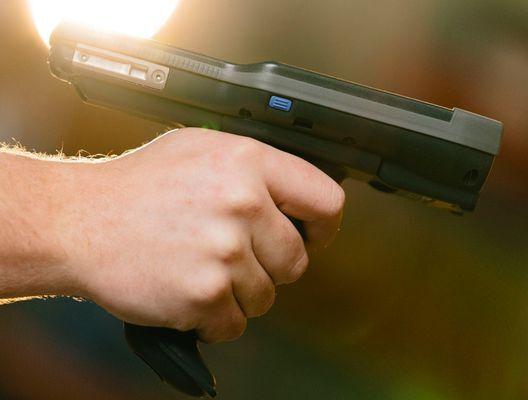
Which option is best?
The choice between red and green depends entirely on the operational environment:
- Choose Green Lasers if: Work is carried out in environments with a lot of natural light or bright outdoor lighting, if employees frequently need to scan at long distances (long-range), or if ergonomics and scanning speed need to be optimized to the highest level.
- Choose Red Lasers if: Scanning mainly takes place in standard indoor lighting conditions, at short to medium distances (within 1–3 meters), and when budget optimization for the purchase of a large PDA fleet is the highest priority.

Optimization with Reverse-IT
At Reverse-IT, we understand that the right hardware setup makes the difference between a disrupted logistics chain and a streamlined process. We supply a wide range of enterprise PDAs equipped with both red and innovative green scan engines from leading brands such as Zebra Technologies, Honeywell, and Datalogic. Our experts are happy to support you with an on-site scan assessment or a test phase (Proof of Concept) to determine which technology delivers the best performance within your warehouse environment.