How Mobile Device Management completes your TMS
Kennis
June 1, 2026
Miranda van Tellingen
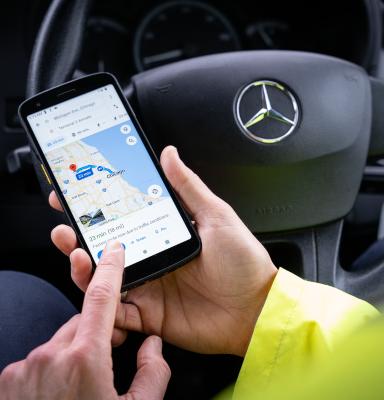
The blind spot in many TMS environments
In most organizations, the focus is on processes within the TMS: orders, planning, time slots, and transport flows. But the devices used by drivers and field service employees—smartphones, scanners, or tablets—are often treated as an afterthought.
Yet these devices are essential for the data flow back into the TMS. Consider:
- Scans that don’t come through
- Applications that freeze or are not up to date
- Connections that drop while on the road
- Invisible malfunctions that are only discovered late
The result? Planners work with incomplete or delayed information, which directly impacts service and efficiency.

Why MDM is becoming increasingly important
Mobile Device Management (MDM) provides control over the entire device layer within your operation. It is not only about security, but especially about operational reliability. With MDM, you gain insight into, among other things:
- The status of devices (online/offline)
- Device performance and malfunctions
- Application versions and updates
- Location and usage information (depending on configuration)
As a result, a direct connection is created between field operations and execution.

From reactive to proactive operations
Without MDM, problems often only become visible when it is already too late: a driver calls because an app is not working or a scan is missing in the system. With MDM, this shifts toward proactive management:
- Malfunctions are detected earlier
- Updates can be deployed centrally
- Devices can be managed or repaired remotely
- Downtime in operations is reduced
This prevents disruptions in the chain and increases the reliability of data in your TMS.

The missing link between planning and execution
A TMS may be perfectly configured, but without a reliable device layer, execution remains vulnerable. It is comparable to a navigation system without a GPS signal: the route is set, but you don’t know whether you will actually arrive as planned. MDM changes that. It forms the connection between the employee and the operation and ensures that the digital chain remains intact outside the organization as well.
With MDM, field data does not only come in, it does so consistently, on time, and reliably. Malfunctions, offline devices, or outdated apps become visible and manageable more quickly, ensuring that the information in your TMS matches reality on the road.

Ddigitalization
Digitalization in transport does not stop at the TMS. In fact, that is where it truly begins. Anyone who wants to maintain control over their operations must look beyond planning and order management alone. Mobile Device Management plays an increasingly important role as the foundation for reliable execution. Or, put more simply: without reliable devices, there is no reliable data.
Want to learn more about how MDM and TMS strengthen each other?
Read our article on Transport Online: The forgotten link: how Mobile Device Management completes your TMS